
Annunci
You need a clear way to decide what work truly matters. Too often teams spread time thin, chasing low-value efforts and losing alignment with business goals. Project prioritization drives portfolio ROI by cutting waste and aligning budgets and capacity to what counts.
Good prioritization helps you stop projects that hurt value and focus teams on the highest-impact product work. Firms that allocate resources dynamically deliver far more value and reduce lead time by cutting work-in-progress.
This section gives a practical framework to turn strategy into clear criteria, weights, and a repeatable model you can run. You’ll learn how to anchor benefits, quantify impact and confidence, and avoid loudest-voice wins.
Expect a friendly, actionable start that shows how to connect decisions, budgets, and capacity so your teams pick the right bets and improve outcomes and success across the organization.
Why strategic prioritization matters right now
When goals move fast, you need a simple way to cut waste and make sure teams spend time on high-impact work.
Annunci
Companies that reallocate resources dynamically deliver much more value: McKinsey finds about a 40% gain in delivered value when allocation is active and responsive. PMI also estimates roughly 20% of projects should be stopped because they don’t align with goals.
You face real costs from context switching. The APA notes multitasking can cut productivity by ~40%. Reducing work-in-progress by half can cut lead times about 50% (Wolfram Müller).
“Dynamic allocation and disciplined stopping rules move value faster and cut portfolio waste.”
Annunci
This is not just theory. At the company level, better use of time and resources turns into measurable growth and impact. You’ll learn practical ways to connect annual strategy to weekly work so goals guide decisions, not posters on a wall.
- Protect value when goals shift.
- Stop misaligned initiatives early.
- Engage teams so priorities stick and deliver.
What “strategic drift” looks like and how to avoid it
You’ll spot drift when projects multiply and your value message blurs into noise. Too many initiatives, siloed decisions, and frequent U-turns are common signs. That mix erodes focus and raises costs while benefits slip away.
You’ll see the problem when projects start without clear business fit and teams work at cross-purposes. Portfolios often carry ~20% waste, as misaligned efforts consume time and cost without delivering benefits (PMI).
Fixing drift means taking visible position on what matters. Make it simple for your teams to say no without political fallout. Clear alignment and discipline stop repeated revisits of the same decision and save time.
- Limit work-in-progress to cut switching costs and improve delivery discipline.
- Map product choices back to strategy so initiatives point the same way.
- Set a regular cadence to revalidate priorities and reduce noise.
“Reducing WIP and enforcing clear alignment turns scattered efforts into measurable value.”
Defining a strategic prioritization model that aligns decisions to strategy
Turn fuzzy trade-offs into a clear decision routine that ties every project back to measurable business outcomes. Use the practical equation Value + Constraints + Buy-In as your working rule. It gives you a concise way to judge work and keep teams focused.
Value + constraints + buy-in: the simple equation that changes everything
Value means measurable benefits tied to business goals. Define criteria that reflect revenue, cost savings, or product reach so choices are about outcomes, not opinions.
Constraints include cost, capacity, and timing. Put these constraints up front so priorities are realistic for delivery teams.
Buy-in is the alignment step. Involve stakeholders to set criteria and weights. A transparent framework reduces politics and speeds agreement.
Turning choices into discipline: linking goals, budgets, and capacity
Use a structured process to connect strategy to budgets and capacity. Quantify weights with a method like AHP so leadership agrees on what matters.
- Define the repeatable process that turns strategy into daily decisions.
- Map initiatives to benefits and resource needs at the product level.
- Link funding to chosen priorities so money follows clear trade-offs.
“A clear equation and repeatable process turn alignment into action.”
Outcomes first: the four benefit types to anchor value
Begin with outcomes: map every effort to a clear business result before discussing features or timelines.
At the product level, you should classify each initiative into one of four benefit types. That keeps your prioritization conversations fact-based and outcome-driven.
Increase revenue and protect revenue
Increase revenue covers moves like entering a new market or launching a premium tier. These are top-line bets meant to grow income and customer reach.
Protect revenue includes renewal programs and churn reduction efforts. These sustain existing income and often have fast payback.
Decrease costs and protect costs
Decrease costs means automating workflows or consolidating vendors to cut spend. These improve margins and free budget for growth.
Protect costs focuses on avoiding cost creep — for example, standardizing hosting or licensing to prevent price drift over time.
- You’ll start with outcomes by mapping initiatives to increase or protect revenue, or decrease or protect costs.
- Use simple examples to pressure-test each decision and surface a clear benefit hypothesis.
- Connect benefits to goals so value is measured, timed, and tied to business strategy.
From intent to action: drivers that move revenue and cost levers
Translate your goals into concrete revenue and cost levers you can test and measure. Start by listing product and market moves that directly affect growth and value.
Revenue drivers include new segments, channels, bundles, and pricing changes. You can also lift customer spend via upsell, cross-sell, or a new tier that fits your product and customers.
Cost drivers are operational efficiency, scale effects, and process automation. Target improvements that reduce costs without harming the customer experience.
- Translate each benefit type into testable drivers and rank them with simple criteria.
- Pick a few high-leverage drivers that match your stage and available resources.
- Capture concrete examples to validate assumptions and refine your approach over time.
Nota: Treat network effects and innovation bets as real options. Use them where they add durable value, not as buzzwords.
“Focus on a small number of measurable drivers and iterate quickly to see real revenue and cost impact.”
Counteracting decay: downward pressure, leverage, and durable advantage
Downward pressure quietly eats at gains; you need deliberate bets that turn short wins into durable leads. Over time, markets saturate and competitors copy fast moves. That decay reduces the value you thought was permanent.
Decay vs. leverage: you can delay erosion by choosing investments that compound. Leverage creates moats — whether through scale or network effects — and turns one-off wins into ongoing growth.
Using Helmer’s 7 Powers to sustain advantage
Map each product initiative to one of Helmer’s powers: Scale Economies, Network Economies, Counter-Positioning, Switching Costs, Branding, Cornered Resource, and Process Power.
- You’ll see decay as a natural force and plan against it.
- You’ll favor leverage that compounds value and strengthens your company position.
- You’ll match revenue moves to network or branding, and cost moves to process or scale.
Esempio: invest in process power to cut cost and lock in efficiency. Or build network effects to raise demand and defend revenue.
“Pick moves that endure, not just spike metrics.”
The lifecycle of advantage and the portfolio you actually need
Your portfolio should mirror how advantages form and fade across a product’s life. That clarity helps you place bets with purpose and measure what success looks like now.
Scoperta funds experiments that test new value and user fit. Keep a small, deliberate budget and clear exit rules so failed tests stop quickly.
Growth backs things that show early traction. Here you invest time and resources to scale impact and amplify reach.
Discovery, growth, extraction, and resisting erosion
Extraction captures the returns: improve margins, raise prices, or squeeze operational gains. Treat extraction as planned work, not accidental maintenance.
Resisting erosion means defending positions that competitors target. Schedule refreshes and guardrails so wins don’t fade over time.
Designing a balanced portfolio of power bets
Balance means you do a few things well. Don’t spread time and budget everywhere. Pick arenas where your company can build and keep real advantage.
- Plan across lifecycle stages so teams know which outcomes to chase.
- Reinforce promising positions with discipline and repeatable review cadences.
- Use examples to choose where to place and defend product bets for compounding value.
- Keep a simple framework visible to all so portfolio balance stays clear and actionable.
Risultato: You’ll stop chasing shiny objects and focus on the few places where sustained innovation and position create lasting value.
The strategic prioritization model
Convert your strategy into a shared scoreboard that ranks initiatives by real business effect. This gives you a clear way to compare work across products and teams.
Start by defining criteria and weights. Use a method like AHP to make trade-offs explicit. Score for value, impact, time horizon, cost, and effort. Publish the weights so everyone sees what counts.
Map initiatives to benefits, drivers, and time horizons
Assign each initiative to one of the four benefit types and a primary driver. Add a time bucket: discovery, growth, extraction, or defense. This makes priorities comparable across your portfolio.
Bake in confidence, timing, and opportunity costs
Attach a confidence score to reflect evidence and risk. Factor in cost of delay and resource capacity so timing and trade-offs are visible. Use stage-gates to stop low-scoring work fast.
- Transparent scores: everyone sees how decisions land.
- Comparable priorities: same framework across product and domain.
- Repeatable process: document steps and publish rationale to speed approvals.
“A simple scoring sheet turns debate into clear decisions.”
Your prioritization toolbox: proven frameworks and when to use them
A compact set of frameworks helps you compare work fast and fairly. Pick the right one by matching scope, data, and team size to the problem at hand.
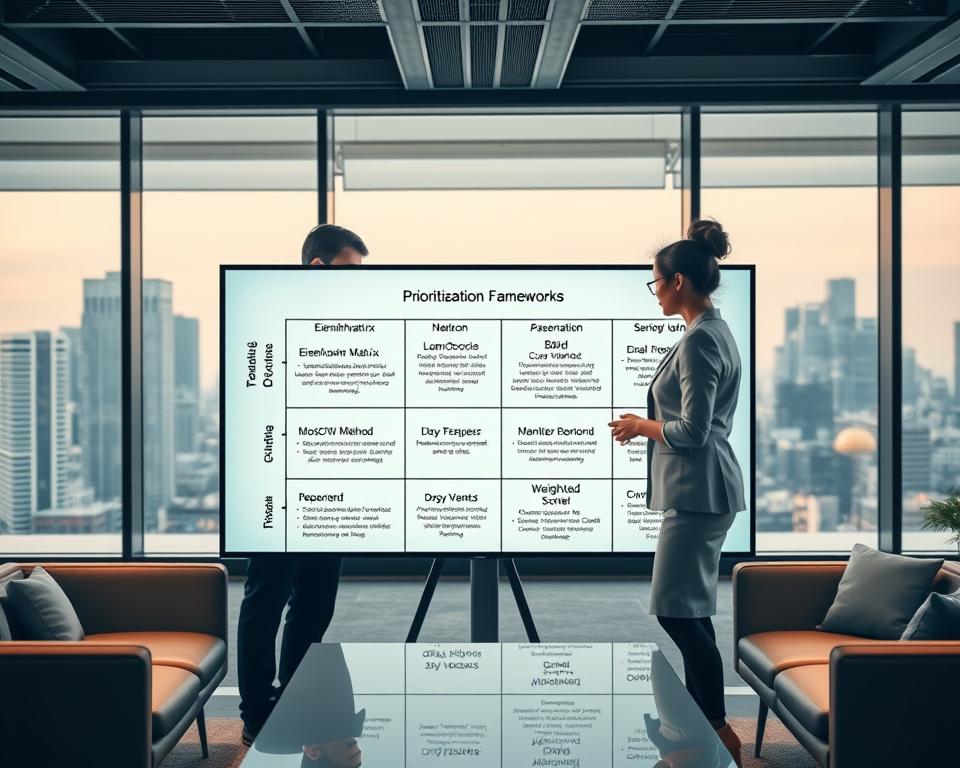
Common tools and what they do
- MoSCoW: Must/Should/Could/Won’t — great for simple communication, but it can bloat backlogs.
- RICE: (Reach × Impact × Confidence) / Effort — ideal for data-friendly teams that want a numeric decision score.
- Impact‑Effort: Visual grid for Quick Wins, Big Bets, Fill‑ins, Money Pits.
- Kano: Separates Basics, Performance, and Delighters to map value for customers.
- DVF: Rate Desirability, Viability, Feasibility (1–10) for balanced product trade-offs.
- Weighted Scoring: Add explicit criteria weights when leadership needs a clear level of value trade-offs.
- Cost of Delay: Estimate value lost per time unit to surface urgency and true cost.
Which framework to choose
Use MoSCoW for fast alignment, RICE when you have reach and data, and Impact‑Effort for small sets or workshops.
Weighted Scoring fits larger portfolios; DVF helps cross‑functional teams test viability. Add Cost of Delay when timing changes value a lot.
“Pick the tool that fits your product stage, team data, and complexity — not the loudest habit.”
Deep dive into scoring methods that reduce bias
A consistent scoring practice removes guesswork and helps teams back decisions with evidence.
RICE: reach, impact, confidence, effort
RICE multiplies Reach and Impact by Confidence, then divides by Effort. Use a shared scale so scores are comparable across product work.
Example anchors help avoid drift: 3 = massive, 2 = high, 1 = medium, 0.5 = low, 0.25 = minimal. Calibrate effort with cross‑functional input to reduce optimism bias.
- Set clear definitions for each scale point.
- Have one engineer and one PM review effort estimates.
- Run a quick sanity check on top 5 scores each cycle.
Weighted scoring and AHP to align leadership on what “strategic” means
Use weighted scoring when you need explicit trade-offs. AHP converts leadership debates into numeric weights via pairwise comparisons.
Keep the process repeatable: publish criteria, run sensitivity checks, and update weights quarterly. Spreadsheets work well, but limit lists to avoid long sheets when you exceed ~30 items.
- Create shared definitions so “strategic” is a measurable level across teams.
- Constrain complexity with guardrails and example anchors.
- Use sensitivity analysis to see how weight changes affect value and final decision.
Visual prioritization and flow: working on the right things at the right time
A simple canvas that plots value and effort makes it easy to choose what your teams do next. Use a clear board so decisions are based on visible trade-offs, not loud opinions.
Impact‑Effort matrix for quick wins, big bets, and money pits
The Impact‑Effort matrix divides work into four quadrants: Quick Wins (high impact, low effort), Big Bets (high impact, high effort), Fill‑ins (low impact, low effort), and Money Pits (low impact, high effort).
Quick wins unlock early value while you stage big bets with clear milestones. Make money pits visible so you can deprioritize them fast.
Reducing WIP, cutting multitasking, and improving throughput
Limit work‑in‑progress to reduce multitasking and lower handoff complexity. The APA notes task switching can cut productivity by about 40%.
Cutting WIP by 50% can roughly halve lead time, and CCPM practices can reduce portfolio costs by 10–50%.
Translate the matrix into a sequence of work and a simple resourcing plan. Use lightweight tools to keep the board current so decisions match time and resources.
- You’ll align teams fast with a shared visual of impact vs. effort.
- You’ll find quick wins to deliver value early and stage big bets responsibly.
- You’ll measure success by lead time and value delivered, not just activity.
“Make choices visible and limit what you start. Flow follows focus.”
Stakeholder alignment: replace politics with decision science
A single playbook for finance, PMO, and delivery removes ambiguity and speeds work.
You’ll move from opinion battles to transparent trade-offs everyone understands. Use clear criteria and published scores so approvals reflect value and goals, not the loudest voice.
From loudest voice to transparent trade-offs
AHP helps quantify value and align leadership on what counts this year. When teams can see how scores are reached, debates focus on data and assumptions.
Publish priorities and rationale so teams trust the outcome. That reduces rework, U-turns, and hidden costs across the company.
PMO, leadership, CFO, and delivery operating from one playbook
- One process, clear roles: PMO, leadership, CFO, and delivery follow the same steps.
- Project-level P&Ls: CFO gets risk visibility and stage gates tied to real benefits.
- Customer and product feedback: Continuous loops update criteria and keep value visible.
“Make trade-offs explicit at the start and you cut politics out of approvals.”
Data, tools, and AI to drive transparency and speed
Bring together demand, capacity, and risk so your portfolio reflects what you can truly deliver. Use a compact set of tools and a clear process to turn signals into action. That makes conversations faster and decisions grounded in facts.
Scenario planning, capacity modeling, and risk visibility
Make scenarios visible. Build a simple model that ties projects to resources, budgets, and time. Run what-if scenarios so you can see how changes affect value and delivery.
- Real-time tools: pick dashboards that show demand, capacity constraints, and stage-gate status at a glance.
- AI forecasts: use machine learning to surface risks and raise confidence in estimates before they become problems.
- Project-level P&Ls: embed financial checkpoints and stage gates so each product keeps meeting business goals.
- Shared view: give organizations a single dashboard to speed prioritization conversations and free up time for delivery.
Keep data fresh and tie product metrics to business KPIs. When your portfolio is a living system, you reallocate quickly and protect value.
Metrics that matter: measuring impact over time
Measure the size and timing of impact so you can move resources to the highest-value work. Good metrics show how outcomes appear over weeks and quarters, not just at project end.
Magnitude, timing, and confidence
Define simple anchors for magnitude and when value is expected to show. Use short time buckets: 0–3 months, 3–12 months, 12+ months.
Track confidence in assumptions with a clear scale. Low confidence flags experiments; high confidence signals scale opportunities.
Review cadence and leading indicators
Set a discipline of monthly check-ins for fast tests and quarterly reviews for larger bets. Use leading indicators to catch stalls early.
- You’ll define metrics for impact and time that reflect how value appears.
- You’ll track confidence and leading indicators to course-correct.
- You’ll enforce reviews so your company pivots resources to winners.
- You’ll link product outcomes to company goals for transparent success.
Balancing quick wins and big bets without losing focus
Quick wins jump-start momentum; big bets create lasting advantage. You need clear rules so both kinds of work support your roadmap, not pull it apart.
Quick wins accelerate learning and deliver visible value fast. They should be low effort and short time bets that improve confidence and build support for larger moves.
Big bets require staged funding, clear milestones, and explicit checkpoints. Break them into phases so each stage shows impact and reduces risk.
Keep focus by limiting concurrent work across teams. When you cap active projects, product groups stop hopping between tasks and finish what matters.
- Rules for choices: pick quick wins when effort is low and impact is testable; fund big bets when evidence points to large value.
- Stage funding: align effort and time to milestones so each phase proves value before more investment.
- Limit WIP: restrict concurrent work so teams keep focus and reduce context switching.
- Tie to strategy: map quick wins to broader goals so early gains compound, not fragment your roadmap.
- Decision checkpoints: set go/no-go reviews to continue, pivot, or stop big bets based on measured impact and confidence.
Real-world signals: diagnosing broken prioritization
A cluttered backlog and constant U-turns are the clearest signals that choices need repair.
You’ll notice easy-to-find problems: too many projects, siloed backlogs, and pet initiatives that never end. These things mask a hidden portfolio where work duplicates effort and eats resources.
Too many projects, siloed backlogs, and zombie initiatives
Endless projects create noise. Teams split time and lose focus, which raises costs and lowers success rates.
Shadow backlogs and siloed work hide true complexity. The APA notes task switching can cut productivity by about 40% — a real cost to customers and teams.
Zombie initiatives keep drawing resources even when they deliver little. PMI estimates around 20% waste from misaligned projects, so spotting and stopping these saves money fast.
What good looks like: aligned strategy, fewer WIP, faster benefits
Good systems cut WIP, tighten approvals, and make priorities visible. You’ll see fewer concurrent efforts and quicker benefit realization.
- You’ll diagnose endless projects and constant U-turns.
- You’ll spot zombie initiatives that consume resources and cost more than they give back.
- You’ll redesign process checkpoints to kill low-value things earlier and realign priorities so teams focus on the few efforts that matter most.
“Reduce WIP and make decisions visible so work flows and benefits show up faster.”
How to implement your model in the next 90 days
In the next three months you can move from debate to decisions with a few focused steps. Start small, prove results, and expand with clear governance so your teams know where to place effort and time.
Build the charter, agree criteria, run pilots, and iterate
Week 0–2: Write a Project Prioritization Charter that defines goals, roles, cadence, and decision levels. Publish the charter so alignment is visible across product and finance.
Week 3–4: Use AHP to set criteria and weights. Share the published model for feedback and calibrate with one clear example.
- Pick 3–5 pilot projects where data exists and run a short pilot.
- Embed stage gates and simple project‑level P&Ls to track cost and value.
- Equip teams with visualization tools and AI scenario planning for resource views.
Month 2–3: Collect outcomes, refine weights monthly, and expand the framework. Train people, add light governance, and scale from pilot to enterprise level when evidence shows repeatable value.
Mancia: If you need a compact execution template, review a sample 30‑60‑90 plan like this 30-60-90 day plan example to map tasks, time, and owners quickly.
Conclusione
Make your next moves predictable: align goals, capacity, and budgets so your teams finish what matters.
You’ve seen how to connect strategy to day-to-day work with a simple, disciplined approach that doubles value without adding resources.
Now you can prioritize transparently, deliver faster outcomes, and keep benefits visible so trust grows and decisions speed up.
Start small: build the charter, run a pilot, and iterate. Measure impact, refine weights, and keep discipline so the company sustains momentum year after year.