
Annunci
You’ll learn practical steps that turn interest into action without forcing a decision. This intro pairs ethical marketing with clear engineering facts, so your messaging and measurements stay aligned.
Start with intent. First align goals, then apply proven frameworks and verified data for any needed calculations. For example, understanding that 1 bar equals 100,000 Pa and roughly 14.5 psi helps you speak the same technical language as engineers.
Next, follow a simple process that maps form field size and page layout to the area-related math behind force per unit area. This keeps your tests and metrics honest and useful.
Ready for a practical roadmap? Use focused design rules and measurement checks. For more on design principles that keep attention where it matters, see this useful conversion-centered design review.
What you really mean by “low pressure conversion” today
Clarify your lens up front: are you talking about ethical marketing that avoids pushiness, or about converting units in an engineering spec? Picking the right frame saves time and prevents mixed signals.
Annunci
Two lenses to use:
Two lenses: ethical marketing vs. engineering unit conversions
- You map the marketing sense to consent, clarity, and choice. That guides messaging, review cadence, and the size of your steps.
- You map the technical sense to measurements in Pa, kPa, bar, or psi. Use the right scale (kPa vs. MPa) and pick a trusted source for constants.
- Decide if your process is proof‑first messaging or factor‑based math. Then bring in vetted data to back each claim or calculation.
Matching your intent to the right process and data
Start with intention, then pick a process that fits the size and space of the task. Small, focused proof works for messages. Scaled units and clear significant figures work for specs.
Finally, identify the real need: are you trying to increase sign‑ups ethically or to convert psi into kPa for a spec sheet? Set a quick review to check your source choices and avoid errors.
Annunci
Low pressure conversion in marketing: Convert without the squeeze
Make trust the opening move: lead with verifiable reviews and clear data so visitors can decide without a hard sell.
Shift from push to proof. Show one strong claim above the fold with a cited source. Use short, honest blurbs from G2 or Capterra and let people check those platforms directly.
Design for ease in mobile and desktop. Keep form fields minimal and labels plain. Give choices—trial or demo, email or SSO—so perceived pressure stays down.
Design for ease: reduce friction in space and scale
Use above-the-fold space for a single benefit statement and move details lower to help scanning. Balance logos and uptime stats so the page breathes.
Your flow: consent, clarity, and choices
- Lead with a short proof point, then offer micro-actions like a video or checklist.
- Simplify the process: fewer fields, clearer CTAs, and empathetic helper text.
- Document tests and reviews so you can later review what changed the level of engagement.
Low pressure conversion in engineering: How to convert pressure units accurately
Good practice starts by locking down definitions: pressure is force divided by area, and the pascal is one newton per square meter (Pa = N/m²). Pick a single source for constants and keep it across documents so colleagues get consistent results.
Know your units: Pa, kPa, MPa, bar, psi, atm (United States context)
Use SI units for calculations and switch to psi when you work on U.S. hydraulics, pneumatics, or tires.
- Pa (base SI): 1 Pa = 1 N/m².
- bar: 1 bar = 100,000 Pa (close to atmospheric at sea level).
- psi: 1 psi = 6,894.757 Pa (common in U.S. specs).
Key factors you’ll use
Memorize these constants and bookmark your trusted tables: 1 bar = 100,000 Pa; 1 psi = 6,894.757 Pa; 1 MPa = 1,000,000 Pa; 1 atm = 101,325 Pa. These values speed accurate work and reduce errors.
Practical notes: match the scale of your readings to the right units—use kPa for small differentials and MPa when specifications rise. Always convert areas correctly when switching between per square inch and per square meter to keep your math valid.
Hands-on process: From bar to psi, Pa, and kPa (and back)
Follow a repeatable math chain to keep your spreadsheets auditable and your reports defensible. Use clear labels, one source for constants, and delay rounding until the final step.
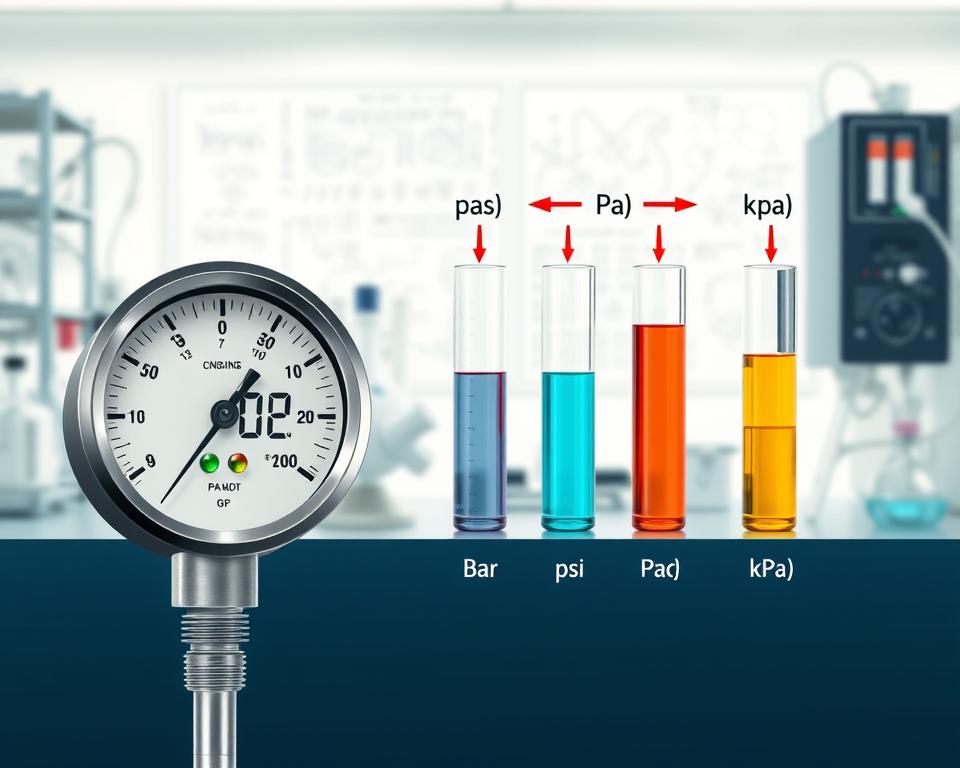
Step-by-step: bar ↔ Pa ↔ kPa ↔ psi with worked examples
Simple chain: multiply bar × 100,000 to get Pa, then ÷ 1,000 for kPa. To reach psi, divide Pa by 6,894.7572931783.
- 2 bar → 200,000 Pa ≈ 29.01 psi.
- 5 bar → 500,000 Pa = 500 kPa ≈ 72.52 psi.
- 10 bar → 1,000,000 Pa = 1,000 kPa ≈ 145.04 psi.
To go back from psi: multiply psi × 6,894.757 to get Pa, then divide for kPa or bar. Always annotate units in each cell so reviewers see intent.
Using scale correctly: when to choose kPa vs. MPa
Choose kPa for mid-range applications like building systems and tires. Pick MPa when values climb into industrial hydraulics to keep numbers readable and avoid many zeros.
“Keep constants in a single data tab so teammates update one source, not dozens.”
Mark edge cases where early rounding changes results and test your process with two independent examples before you finalize a spec. This protects accuracy and makes your work easy to audit.
Unit accuracy essentials: Area, size, and application context
Begin by linking force to surface: how much area you measure changes the value you report. Remember that 1 psi = 6,894.7572931783 Pa, which ties pound‑force to one square inch.
Why “per square inch” matters: psi is pound‑force per square inch, so changing the contact area alters reported results even when force stays the same. Always double‑check in² ↔ m² conversions to avoid order‑of‑magnitude errors.
Avoiding common pitfalls
- Label gauges: note psig vs. psia so readers know if values are relative or absolute.
- Pick the right constants: use 3,386.38 Pa/inHg at 32°F or 3,376.85 Pa/inHg at 60°F as your test requires.
- Account for water column temperature: 1 inH2O = 249.082 Pa (4°C) or 248.843 Pa (60°F).
- Use 1 atm = 101,325 Pa and 1 MPa = 1,000,000 Pa for cross‑checks on legacy specs.
- Choose unit size by application: kPa for moderate ranges, MPa when numbers get large.
“Run a quick peer review focused on units, area, and temperature constants before you publish.”
Keep a short style guide and capture lessons learned so your next review goes faster and safer.
Low pressure conversion tools and data you can trust
Keep a compact reference set at hand so you can check common values fast when you work in the field.
Reference tables for 0–50 bar: quick picks for tires, hydraulics, and building services
Make a 0–50 bar table that lists bar, Pa, kPa, and psi for common checkpoints. Include rows at 1, 5, 10, 20, and 50 bar so you cover typical ranges.
- 1 bar = 100,000 Pa = 100 kPa ≈ 14.5 psi
- 10 bar = 1,000,000 Pa = 1,000 kPa ≈ 145.04 psi
- 50 bar = 5,000,000 Pa = 5,000 kPa ≈ 725.2 psi
Source-backed constants: atm, inHg, Torr, and water column at standard temps
Header your table with trusted constants: 1 atm = 101,325 Pa; 1 psi = 6,894.7572931783 Pa; 1 Torr = 133.3223684211 Pa.
Add inHg (32°F = 3,386.38 Pa; 60°F = 3,376.85 Pa) and inH2O (4°C = 249.082 Pa; 60°F = 248.843 Pa). Include MPa for higher ranges so numbers stay readable.
“Save versions with a changelog and run a quick review against two independent conversions before you publish.”
Label your data sources and keep a short list of vetted articles for teammates. Exportable snippets and mobile‑friendly tables make field checks fast and reliable.
Review and refine your process: A quick checklist
Before you finalize anything, run a short checklist that separates messaging choices from measurement steps.
Quick checks to run now:
- Confirm intent: are you optimizing persuasion or doing engineering math? Pick the matching checklist path.
- Verify unit choices: use psi for U.S. specs, kPa for readability, and MPa when values get large. Note gauge vs. absolute.
- Lock your constants at the top of the sheet: 1 bar = 100,000 Pa; 1 psi = 6,894.7572931783 Pa; 1 MPa = 1,000,000 Pa; 1 atm = 101,325 Pa. Protect those cells.
- Trace every step with explicit units. Check arithmetic and delay rounding until the final cell to avoid errors.
Scan for temperature-sensitive measures (inHg, inH2O) and match constants to the stated temp. Run two spot checks, for example 2 bar ≈ 29.01 psi and 10 bar ≈ 145.04 psi, to confirm your pressures align with expectations.
“Document why you chose a scale or message and keep links to sources visible for future audits.”
Trim friction in marketing flows: simplify fields, clarify CTAs, and surface proof above the fold. Then schedule a short peer review so both math and messaging pass a fresh set of eyes. For a tidy checklist for CRO tasks, see the ecommerce CRO checklist.
Conclusione
Wrap up with a clear intent, a tested process, and a small set of verified data you can reuse.
Rule of thumb: pressure depends on area, and unit choice affects readability. Remember the core constants: 1 bar = 100,000 Pa; 1 psi = 6,894.7572931783 Pa; 1 MPa = 1,000,000 Pa; 1 atm = 101,325 Pa.
Keep a short checklist you run before publish: define intent, pick a repeatable process, lock your constants, and note unit size for each audience. Share tables and flows with your team so results stay consistent.
Thanks for reading. Thanks for caring about accuracy and respect. Thanks for choosing a low pressure approach that builds trust over time.