Anúncios
What if the next big breakthrough in design is already hiding in plain sight—on a lotus leaf or a kingfisher’s beak?
You step into a world where biomimicry turns curiosities from nature into real tools you can use today. From Velcro and lotus-effect coatings to the Shinkansen nose and Eastgate Centre, these examples show clear wins in energy, noise, and efficiency.
Over time, engineers and students prototype ideas with recycled parts, following a simple roadmap: observe, plan, build, test, and share. That process mirrors evolution’s trial-and-error and yields practical results across the world.
This article gives you a friendly path to see how design thinking converts a wild idea into working solutions. You’ll meet makers and researchers, learn measurable outcomes, and grasp where value appears in present-day applications.
Why you’re seeing a surge in nature-inspired innovation right now
Nature’s long experiment gives engineers ready-made patterns to solve modern problems faster.
Anúncios
Evolution acts like an R&D lab. It produces designs—owl feathers that cut noise, kingfisher bills that shape train noses, lotus leaves that shed water, and termite mounds that ventilate buildings.
- Proven blueprints: You tap into solutions that have already been field-tested by life, lowering design risk.
- Faster prototyping: Better materials, simulation, and 3D printing let you copy forms and test variations quickly.
- Global urgency: Climate, water, and energy pressures push teams to find ways that use less input and create fewer harms.
- Team gains: When scientists and designers work with engineers, adaptations move from idea to manufacturable parts.
- Scale and policy: Coatings or whole systems can scale, and sustainability goals make commercialization more practical.
You benefit because these approaches show clear wins—quieter trains, self-cooling buildings, and cheaper prototypes—that make solutions easier to adopt across the world.
Top breakthroughs in bio inspired technology you should know today
Take a quick tour of the most important nature-to-product breakthroughs shaping what you use today.
Anúncios
Practical wins: Engineers copied a kingfisher’s bill to reshape the Shinkansen nose, cutting tunnel booms and trimming energy use by about 15% while boosting speed. WhalePower’s tubercled blades delay stall and raise lift for wind and hydro blades. Ornilux uses spiderweb-like UV patterns to keep birds safe, and sharkskin riblets cut drag on hulls and aircraft.
- Fog-harvesting surfaces modeled on the Namib beetle bring water to arid towns and farms.
- Aquaporin and diatom-like filters lower energy needs for clean water systems.
- Mussel-style adhesives bond underwater for reef repairs without toxins.
- Self-healing concrete and termite-style passive cooling reduce repair and HVAC loads.
Each example shows clear ways nature informs better design and smarter engineering across the world. Use this snapshot to spot where nature-led ideas can solve your next problem.
From kingfisher to Shinkansen: How a bird’s beak reshaped the bullet train
A bird’s streamlined beak helped engineers rewrite how the Shinkansen meets air at tunnel mouths.
The kingfisher dives from air into water with almost no splash. Engineers studied that fish‑hunting skill and copied the long, tapered front and head profile to reshape the train nose. This new shape reduces pressure spikes when the train enters and exits tunnels.
Silencing the sonic boom: Reducing tunnel-exit noise with a new nose shape
The redesigned nose cuts the tunnel-exit boom and overall noise, so communities beside the line hear far less disruption even at high speeds. The bird-beak geometry tames pressure waves and smooths how air flows around the front.
Using less energy and going faster: What engineers learned from air-water transitions
The result is measurable. The refined profile used about 15% less electricity and ran roughly 10% faster. Engineers also reworked the pantograph, borrowing owl-feather flow tricks to lower aerodynamic noise from the roof equipment.
- You see how a natural shape translated into smoother airflow and lower drag.
- You learn why residents hear fewer booms and why passengers enjoy quicker trips.
- You get why the Shinkansen bullet example ranks high among real-world wins from observing animals.
Whale fins and wind turbines: Tubercle-inspired blades that lift performance
You might not expect a whale’s fin to teach wind engineers how to squeeze more power from light breezes.
Humpback whales carry rows of bumps along their fin edges that change how flow behaves. Frank Fish and other scientists measured that tubercles raise stall angle by nearly 40% versus smooth edges.
Why humpback fins stall later and turn tighter
The bumps split and reattach flow, so the animal keeps lift at steeper angles and makes tight turns in the sea. Tests show tubercled blades cut drag by up to 33% and raise lift around 8%.
Quieter, more efficient wind turbines for communities and grids
Those same flow tricks moved into real-world wind turbines. Companies like WhalePower commercialized serrated-edge blades and report quieter operation and better low-wind start-up performance.
- You see how tubercles delay stall and boost rotor ability in gusts.
- Small edge changes can improve grid reliability without a full rotor redesign.
- That simple design tweak often lowers noise for nearby neighborhoods.
Pulling water from thin air: Desert beetles guide next‑gen water capture
A small beetle on the Namib shore shows how surfaces can pull moisture from air.
The Namib Desert species uses a clever mix of wettable bumps and water‑repelling ridges to turn fog into a steady trickle toward its mouth.
That simple surface logic scales well. Scientists copied the beetle’s hydrophilic bumps and hydrophobic channels to steer tiny droplets without pumps or power.
Fog-to-flow: Bumps and ridges that channel droplets where you need them
MIT teams built glass and plastic prototypes that harvest minute droplets and let them merge into useful volumes.
Industrial groups also applied the same idea. Infinite Cooling captures evaporating plumes from cooling towers and returns water to plant loops, lowering fresh withdrawals.
- You see how a beetle shell condenses fog on wettable bumps then routes it along slick ridges.
- These designs create new ways to reclaim water where it’s scarce, from farms to factories.
- Tuning textures and angles makes the approach work across climates and airflow patterns.
In short, a microtexture from one species can reshape facility water management at scale. You get efficient fluid control with no moving parts, just smart surface design.
Copying aquaporins and diatoms: A new way to filter and desalinate water
Imagine membranes that mimic a cell’s gatekeepers to move pure water with far less pressure.
You can think of aquaporin channels as ultra-selective doors: they pass single water molecules quickly while blocking salts and larger contaminants.
Cell-level inspiration: Letting water in, keeping contaminants out
Aquaporins act like one-way gates for water, offering a model for ultra-selective filtration. The trick is keeping those proteins stable outside a cell membrane so they keep working in a manufactured filter.
Protecting fragile membranes with diatom-like silica structures
Researchers, including teams in Sweden and startups like Aquammodate, embed aquaporins into support layers. They use materials modeled on diatom silica to shelter the channels and resist fouling.
- You learn how aquaporins pass water while blocking solutes for very high selectivity.
- You see why stabilizing proteins is tough and how silica-like supports protect them.
- You discover this approach targets lower-pressure, lower-energy operation than reverse osmosis.
- You explore how such design could solve human needs in cities, industry, and remote sites.
The result: a path toward energy-efficient, non-toxic filtration that connects cell biology and materials engineering to reshape how we treat water at scale.
A gentler poke: Mosquito-inspired microneedles that reduce pain
A mosquito’s stealthy method for piercing skin taught engineers a gentler way to deliver medicine.
Studies by M. K. Ramasubramanian, O. M. Barham, and V. Swaminathan show multi-prong microneedle designs that mimic the layered, serrated motion of a proboscis. These needles enter skin with far less force, so injections feel milder for humans.
The advantage: small prongs and smart tip geometry cut vibration and friction. The result is smoother insertion and higher comfort.
- You learn how multiple tiny prongs lower insertion force and improve the ability to deliver drugs.
- Materials and surface finishes reduce friction for a cleaner entry.
- Scientists map the proboscis sequence to solve a common clinical problem and enable easier self-care.
Better comfort can raise adherence to therapies and open paths for at-home devices. If a simple redesign removes fear of shots, people may stick to treatment more easily. For more on the science behind these advances, see the microneedle research at microneedle research.
Vaccines that travel better: Anhydrobiotic organisms inspire room‑temp storage
Organisms that shut down without water offer lessons for making vaccines tough at room temperature.
Nova Laboratories developed a method that dehydrates vaccines in a protective sugar syrup. The sugars keep proteins and adjuvants stable and stop bacterial growth during storage.
Sugars, dehydration, and reactivation inside the human body
When you inject the dried vaccine, body fluids rehydrate the particles and reactivate the immune signal. That reactivation restores potency without deep cold, easing logistics for remote clinics and campaign teams.
- You see how lessons from desiccation-tolerant life help scientists stabilize doses without frozen chains.
- You learn why sugars protect fragile structures when water is removed, preserving activity over time.
- You discover that rehydration on injection gets vaccines working again for people far from refrigeration.
- You appreciate how this approach can solve human public health challenges and cut cold-chain waste.
As this technology advances, expect trade-offs: stability testing, dosing checks, and regulatory review. Still, the molecular trick links to big system gains for routine immunizations and emergency response.
Sharkskin to ship hulls and swimsuits: Riblets that cut drag and deter microbes
Tiny ridges on a shark’s skin change how water slides by, and that simple idea travels far beyond the ocean.
Riblet films model shark denticles to reshape boundary layers and lower friction. You see this effect in the sea and in air, from racing yachts to high-speed aircraft.
From ocean predators to aircraft and submarines
Practical crossover: NASA tested riblets on the America’s Cup Stars & Stripes and found real gains. You can apply riblet films to hulls, fuselages, and even performance swimwear.
Saving fuel at scale: The big impact of small friction changes
Small percent drops in drag add up. Researchers estimate a 1% drag reduction can save about 25,000 gallons of fuel per aircraft per year.
- You explore how microscopic riblets reshape flow to cut drag in the sea and the air.
- Riblets deter microbes and fouling, which lowers maintenance and keeps performance high longer.
- Film-based products let you retrofit fleets without full refits, so savings arrive fast.
- This design stacks with other upgrades—engines, coatings, and aerodynamics—for compounding gains.
- You can read broader marine findings in a focused marine science review that explores surface flow effects across the world.
Bottom line: an elegant pattern from nature turns into real cost, fuel, and emissions savings in many ways you can use today.
Mussels show the way: Non‑toxic underwater adhesives for reefs and repairs
A sticky secret from tide pools gives you a better way to fix things under waves.
Mussel polymers replicate adhesive proteins that bond while wet and hold in fast currents. Mussel Polymers Inc. reports bonds that are three times stronger than some alternatives and remain non-toxic. That makes repair and restoration safer for reefs and marine habitats.
Sticking strong in moving water without harming sea life
You’ll see how mussel foot proteins led to fast-setting glues that work in flowing water.
- You discover adhesives that set quickly and stay strong in currents.
- You learn why non-toxic chemistry matters for the sea and how it solves human problems without harmful leaching.
- Engineers test these materials to stabilize coral, patch infrastructure, and secure sensors for people working underwater.
- Easy-to-apply cartridges mean divers and crews can make repairs faster and cut repeat maintenance dives.
The result: a simple biological trick turned into practical materials that speed conservation and lower cost for marine work.
Concrete that heals like skin: Bacteria-driven crack repair
Imagine concrete that patches its own cracks the way skin seals a cut.
Researchers embed limestone-producing Bacillus spores into concrete so the material can react when damaged.
Activating limestone production when air and water seep in
When microcracks admit air and water, dormant spores wake and metabolize a tiny nutrient package. They then precipitate limestone to fill gaps.
Hendrik Marius Jonkers’ work in the Netherlands shows these bacteria can survive long periods—potentially up to 200 years—cutting repair cycles and saving your maintenance time and cost.
- You learn how bacteria inside concrete “wake up” with water and air and seal cracks like skin.
- You see the design logic: dormant spores, an internal nutrient source, and a supporting matrix that activates only where needed.
- You appreciate that materials choices balance strength, compatibility, and long bacterial survival for real-world use.
- You consider applications from tunnels to marine structures where small cracks drive big problems and lifecycle carbon falls with fewer repairs.
Buildings that breathe: Termite mound strategies for cooling big spaces
Imagine a building that uses simple airflow paths and heavy walls to stay cool without constant fans.
The Eastgate Centre in Harare shows how that idea works in practice. It draws outside air through channels and uses the building’s thermal mass to condition the flow.
Eastgate Centre’s self-ventilating design in action
Rather than run HVAC non-stop, Eastgate moves air through ducts and cavities that warm and cool the structure at different times of day.
The approach lowers energy use compared with similar office towers and keeps temperatures steady for people inside.
Cutting HVAC energy while keeping people comfortable
The trick is simple: thick walls buffer day-night swings, and vents open on a schedule tuned to local climate and occupancy. Engineers set vent sizes and timers so fresh air arrives when needed.
- You see how termite mounds inspired ducting and passive vent controls that move air naturally through large spaces.
- Thermal mass buffers swings, so steady comfort arrives with minimal mechanical cooling.
- Sensors and smart controls refine flow, improve indoor air quality, and reduce peak loads for backup systems.
- The Eastgate example proves this isn’t theory—it’s a working design that saves energy in the world today.
Nature’s network planner: Slime mold patterns for smarter cities and rails
A single-celled slime mold can sketch transit maps that make planners pause and rethink routes.
In one well-known experiment, scientists arranged bits of food to match major Japanese cities. Within five to six days, Physarum polycephalum grew a web that closely resembled the country’s rail network.
The takeaway: this living solver finds efficient paths quickly and shows redundancy and fault tolerance in surprising ways.
Adaptive routing that beats trial-and-error engineering
You see how a brainless organism helps planners visualize robust connections that support train and bus routing, emergency logistics, and utility corridors.
- You learn how slime mold links points fast and echoes existing routes at remarkable speeds.
- You appreciate that iterative, nature-like growth can outperform top-down trial and error for some design problems.
- You discover hybrid workflows: combine slime-mold maps with human constraints to create practical plans for the world’s cities.
- You explore using the same logic for data networks and supply chains to expose non-obvious, low-resource ways to connect a region.
Everyday wins from the wild: Three nature-inspired designs you use today
A simple walk can reveal how nature solved problems you face every day.
Velcro and burdock burrs: Tiny hooks, big grip
George de Mestral noticed burrs on his dog after a hike. Under a microscope he found tiny hooks that latched to loops. That led to Velcro: a rugged fastener built on hooks that hold and release easily.
Lotus-effect coatings: Ultra water-repellent, self-cleaning surfaces
The lotus leaf sheds water so droplets bead up and roll off. Coatings copy that microtexture so water takes dust with it. The result keeps panels and facades cleaner with less washing and less wear on the skin of surfaces.
Spiderweb-informed glass: Ornilux patterns birds can see and avoid
Ornilux BirdSafe Glass borrows UV cues like spiderweb strands. Birds spot the pattern and steer clear, which cuts collisions without blocking your view.
- You smile at how a walk with your dog turned burrs into Velcro — a neat, real-world example of hooks at work.
- You notice lotus-effect finishes on building panels that shed water and grime with no effort.
- You appreciate Ornilux glass, where a tiny visual signal protects birds while keeping windows clear.
Bottom line: the natural world hands you simple, useful solutions. Look closely — animals and plants in your neighborhood often show the next useful idea for the world around you.
Mycelium materials: Fungi turning waste into strong, green building parts
Fungal networks are quietly turning waste streams into strong, lightweight building parts.
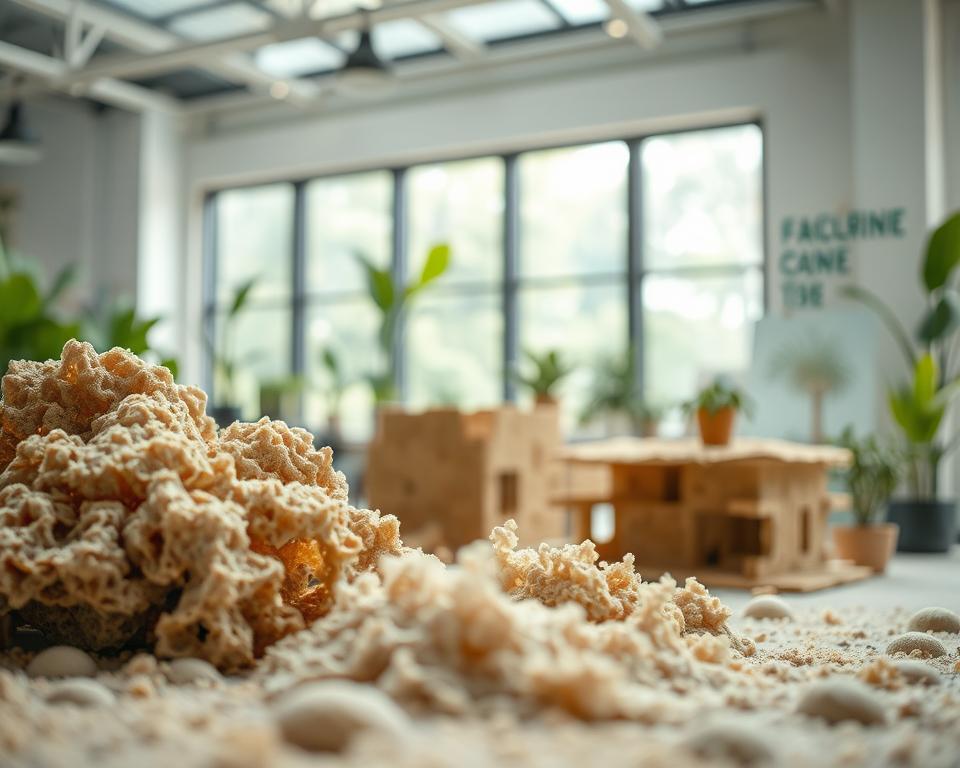
You can find panels from companies like Biohm that use mycelium to bind fibers into solid, lightweight boards.
These pieces act as biodegradable, non-toxic insulation that rivals conventional options. Researchers also explore using mycelium to upcycle plastics and agricultural waste into molded components.
- You learn how mycelium binds fibers into panels that insulate and damp sound.
- You see how designers shape parts from waste streams, turning a disposal problem into useful building goods.
- You appreciate that these materials are compostable, safer to handle, and cut embodied carbon across a lifecycle.
- You discover pathways to replace foam or mineral insulation with plant-fungal composites for interior use.
- You imagine local “bio-factory” models that use regional feedstocks to lower transport and bolster circular systems for humans and the world.
Next steps: wider adoption will hinge on certification, code approvals, and scaling molds for furniture, packaging, and interior components.
Try this at home: Become an engineer with bio-inspired design
Observe, sketch, build, and test: a simple loop that turns animal features into human solutions.
Follow a Smithsonian-style flow to learn about animal adaptations, watch a short video, plan a concept, and build a quick model. Use recycled cardboard, tubes, and containers so you spend little money and save time.
Spot adaptations and translate them into real fixes
You act like engineers by first watching animals—how a frog’s eyes, a beetle’s back, or a whale’s fins solve specific tasks. Pick a human problem and sketch a simple feature that borrows the function, not the exact form.
Build fast, test often, and share your work
- Gather recycled materials and assemble a rough prototype in an hour.
- Test quickly, note what works, and tweak angles, textures, or parts.
- Document your steps and write a short story so people see how the natural world helped solve human problems.
- Share photos and notes to inspire others and discover new ways to improve the idea.
Conclusion
When engineers borrow a function from animals, practical solutions often arrive faster and cleaner.
Across transport, energy, water, health, materials, and safety, biomimicry shows how modern technology picks reliable cues from the living world.
You now have proof points—quieter trains, stronger blades, cleaner water, gentler needles, self‑healing concrete, and safer glass—that show small changes in design can solve a big problem.
Look to nature, test fast, and share results. In short time, simple steps let you act like an engineer, spot chances in daily life, and turn ideas into useful projects across the world.